Tuesday, July 7, 2015

Oaxaca: Monte Albán and a Oaxacan lunch


Our second day at the NEH Mesoamerican Institute is off to a wonderful start. I will share pictures and stories from our excursions to Monte Albán and Atzompa, but first, a quick story about my encounter at lunch today. After our long day of excursions, and due to the lack of kitchen in my apartment, I took myself out to eat at a local restaurant. My lunch was quite the deal, in fact, at 35 pesos (roughly two US dollars) for the menú del día; a drink, a first dish (hot vegetable soup), a second dish (rice, salad and fried Oaxacan cheese), and a dessert.

I sat down at a small table to eat my lunch, and just as I had ordered my meal, a woman walking with two work colleagues approached me and asked in Spanish if my table was free. I said “yes, besides me!”, and just like that I had three new friends to eat lunch with at my (very) small table. So small, that our plates were touching.


No matter! We had a fantastic conversation, Maribel, José Luis, Elliot and I, and it was my chance to ask about the teacher protests and political unrest that is so present throughout the city of Oaxaca. I shared stories of the unrest, protests and riots that had taken place in Baltimore, and my new friends had heard of Freddie Grey and the unrest in our city, and were able to relate. They were surprised to hear that I had taught social justice topics in my classroom, and that my students were incredibly attentive to the story of the 43 missing student teachers in the state of Guerrero. I also got tips on where to find the best markets, and help with the pronunciation of the festival of Guelaguetza (it took me about four times to pronounce it correctly!) A wonderful chance to practice my Spanish and meet a few new friends, all while gaining a bit of perspective on local political movements in Oaxaca.

Monday, July 6, 2015

Oaxaca: Mazatec and the language of whistling

Our first day in the National Endowment of the Humanities (NEH) Summer Institute has been an inspiring experience. After our opening reception last night hosted by Stephanie Wood, professor at the University of Oregon, I had a chance to meet all 28 of the teachers in the program, and each of the professors that will be hosting us here in Oaxaca for the month of July.


Our classroom is a beautiful library that doubles as a museum and a meeting place for scholarly groups. Our lecture for the evening was hosted by linguist Michael Swanton (pictured below), who specializes in studying the many indigenous languages of Oaxaca.


As explained to us by Michael Swanton, there are more than 6,000 languages that exist throughout the world, and 365 of those languages are spoken in Oaxaca. At the date of Mexican Independence in 1821, 70% of Mexico's population spoke an indigenous language fluently. Today, only 7% of Mexico's population speaks an indigenous language. But in Oaxaca, 33% of the population speaks an indigenous language, and indigenous culture is alive and well throughout Oaxaca. 


The second part of our lecture was given in Spanish and Mazatec, by Gabriela García García (pictured below) of Oaxaca City. A librarian and historian in the library where we are studying, Gabriela was an inspiring and engaging speaker. Gabriela explained to us the method of whistling, or Chifla, which is used throughout the Mazatec language daily. She explained that you can hold an entire conversation through whistling, as Mazatec is a tonal language, and therefore can be replicated through whistling. Commonly, men are the whistlers in society, but as Gabriela grew up with older brothers, she was a bit of a "tomboy" and knew how to whistle!


The language of Mazatec "chifla" or whistling is different in every family, but there are regional whistles that are globally recognized and used in everyday conversation. Gabriela also explained that through whistling basketball players are able to call each other to gather for games, and speak through whistling during games instead of giving spoken commands. An impressive benefit and daunting threat to any opposing teams! 


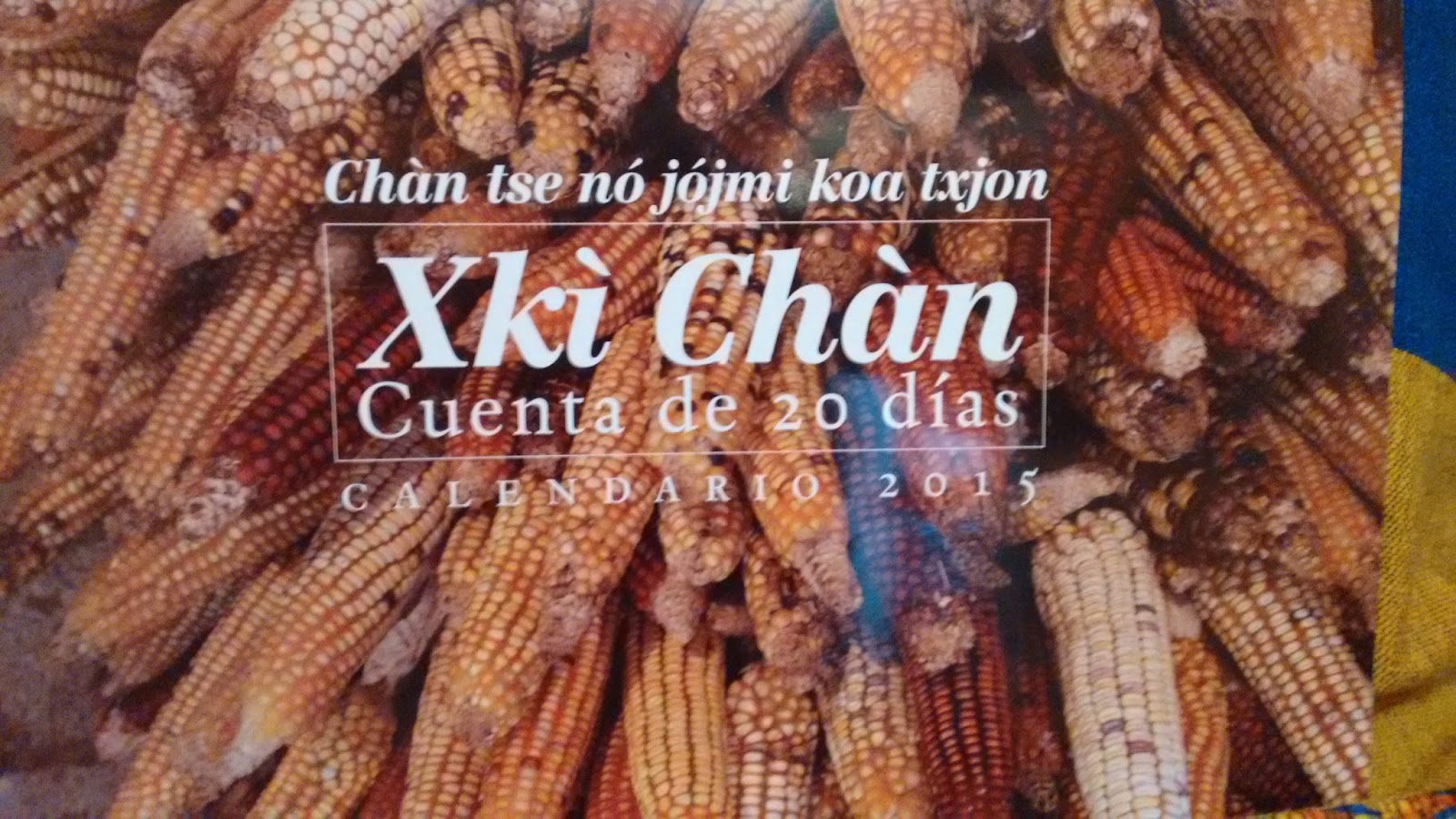
I was also able to purchase a Mazatec calendar, with photos and original poetry in Mazatec, which was translated into Spanish, and written by Gabriela. She also taught me how to say "hola" in Mazatec:"nadalí".
(Pronounced like "Salvador DALÍ").

What an inspiring first day of Institute!