Thursday, February 16, 2017

Blossoms of Fire - A Film Resource

Another of my favorite film resources is the film "Blossoms of Fire" by Maureen Gosling. I discovered this film in the National Endowment of the Humanities Institute in Oaxaca, when it was introduced to our group by Professor Stephanie Wood. 


As our group chuckled along with and were encompassed by the lives of the strong women of the Isthmus of Oaxaca, I realized that this would be a wonderful resource to use in my Spanish I classroom.

With this film resource, students are able to connect with and empathize with the strong women of the Isthmus, and see the vibrant and friendly communities that exist in one of Oaxaca's most storied communities.


 This resource can be used as a 2 day lesson, or as a film-based exam (Criterion A, for MYP/IB teachers). 

To access the film resource, please visit my TpT page at the following link:


The film can be purchased at the following link:


Enjoy!


Rebelión en Oaxaca: Film Resource

A film that I've used with great success in my IB Spanish I course for the last two years is the film "Women, Media and Rebellion in Oaxaca". If you're looking for opportunities to teach your students about social justice in Latin America in a comprehensible way, look no further. 

In this film by Gabriela Martinez Escobar, a professor at the University of Oregon, Gabriela delves into the complexities of the 2006 rebellion in Oaxaca from the point of view of the women who helped to spur the movement. Not only does this film focus on the pivotal women in the uprising, but it also focuses extensively on educational issues and the role that teachers played throughout the movement. 


This is a two day lesson plan that helps students to reflect on the power of peaceful protest. Although the resource could be used as a lesson plan, I have also used the worksheet a Criterion A Summative Assessment (for MYP/IB teachers). To access the film resource, please visit my TpT page at the following link:

https://www.teacherspayteachers.com/Product/Rebellion-in-Oaxaca-A-film-based-exam-3005101


If you'd like to preview the film before using the resource (which I highly suggest), please visit :


The film resource utilizes the segment from 0:00 - 14:00 and 25:25 - 27:00.


Wednesday, February 15, 2017

Rebelión en Oaxaca: Resources for teaching students about the Oaxacan Uprising of 2006


¡Hola amigos! Today I'd like to share a few resources with you that are close to my heart. One of the most charming places I've travelled is the state of Oaxaca, and as you can see by my earlier blog post, I'm quite enamored with this Mexican state. I first visited Oaxaca when I was 19, and it has captured by attention ever since. 


In my second year teaching in Baltimore, I applied to attend the NEH (National Endowment of the Humanities) Mesoamerican Institute, taking place in Oaxaca, Mexico that summer. I was lucky enough to be able to join this outstanding group of twenty educators from across the United States for the month of July to learn about the continuation of Mesoamerican culture throughout Oaxaca. 


Due to the inspiring instruction given by Dr. Stephanie Wood and Dr. Robert Haskett, I was able to create a plethora of resources for the high school Spanish classroom that center around the rich cultural heritage of Mesoamerican culture in Oaxaca.

In the reading I created,"Tengan Puestos Los Ojos en Oaxaca", students will learn about the 2006 uprising in Oaxaca that centered around the teacher protests for better school funding. This engaging and comprehensible reading can be used for Spanish I or Spanish II, and can be accessed at the following link:

https://www.teacherspayteachers.com/Product/Teacher-Protests-in-Oaxaca-Mexico-Spanish-Reading-2983213


When teaching students a comprehensible lesson with a social justice theme, I begin with a standard routine so students don't feel overwhelmed by any new vocabulary they may encounter. 

First, students define the words at the top of the page. I begin by using TPR actions to teach the words and phrases, and then give students time to write the definitions of the phrases.

Second, I give students five minutes to silently read through the passage, with the instruction to underline cognates and circle any new or unknown words. 

Third, we define the words that students circled in the reading as a group, and students annotate the meaning of these words in their reading.

Fourth, the students and I read the passage as a group in a chorus, to teach students inflection and pacing while reading aloud. This also helps to build student confidence in reading in front of their peers.

Fifth, students complete the "Airplane Reading" segment of the reading, which consists of students reading together in rotating pairs. Please see my post on the "Airplane Reading" method if you are unfamiliar with the term.

Sixth, after students have completed the "Airplane Reading" segment, students answer the comprehension questions in Activity 2, forming full sentences and working with a partner.

Finally, students describe what they see in the photos and paintings provided in Activity 3, by forming full sentences to describe what they see. Each sentence should start with the phrase "Veo que hay...".

Enjoy!


Tuesday, February 7, 2017

El Día de San Valentín


¡Feliz día de San Valentín! This week in preparation for Valentine's day my IB Spanish I students are focusing on a holiday themed unit. This short unit focuses around reflexive verbs, which can be challenging to teach in a full-immersion classroom with first year language students. Therefore, teaching grammar with an engaging theme, in an exciting and comprehensible way, is essential. 


My favorite unit to utilize when teaching reflexive verbs is Martina Bex's four day unit based on a short film entitled "La Receta de Amor". 

This comprehensible story, based on a short film, centers on a technique called movie talk which I have found to be very effective in my classroom. See Martina's excellent explanation about movietalk at the following link: 


Student engagement in the short film's movietalk portion is teacher-centered, and the movietalk can take quite a bit of practice on the teacher's side to be made into a useful tool for your comprehensible classroom. 

But, please don't be scared off! A successful movie talk can spur almost a week's worth of comprehensible activity that focuses around a relevant grammar topic (such as reflexive verbs, in this case), which proves to be invaluable for student engagement and recall of the grammar taught within the unit. 

If you're interested in teaching Martina Bex's unit, follow the link below. I highly recommend this outstanding unit!


Within this unit, I've found it very helpful to have a class set of whiteboards for student CFU responses. While the class set does not absolutely have to be purchased to teach the unit, I use the student whiteboards at least once a week, and they have proven invaluable for my student's understanding of complex tasks. 

I purchased this set (I bought 3 packs):

https://www.amazon.com/Charles-Leonard-Lapboard-Whiteboards-35036/dp/B00JFKQTPG/ref=sr_1_2?ie=UTF8&qid=1486552226&sr=8-2&keywords=whiteboard+classroom+set

And these markers: 


Thanks for stopping by! If you're interested in teaching a few of my resources, check out my TpT page, we're throwing a sale!


¡Feliz día de San Valentín!

Friday, February 3, 2017

Nuevo Sencillo de Natalia Lafourcade: "Tú sí sabes quererme" - Natalia Lafourcade's New Single: "You Know How to Love Me"


Natalia Lafourcade has been a favorite artist of mine for the last four years, since I first taught her gorgeous tune "Amor de Mis Amores" to my Spanish I students. In a homage album to Agustín Lara, Natalia captured the hearts of my students with her cheerful and fresh rendition of a 1930's Mexican classic. 


Throughout four years of teaching "Amor de Mis Amores" as the Spanish I introduction to "Haz Ahora" songs, now most students at my school that have taken Spanish know the tune, and students tell me that the tune helps them connect with upperclassman who have fond memories of the class and their first Spanish song. Music has such power to invoke memories, and I love that students have such fond memories of Natalia's rendition of this classic tune.


Since then, I have taught Natalia's "Adventurera" from the same Agustín Lara tribute album, as well as her tune "Ella es bonita". 


I am a big fan of her newest album, "Hasta la Raíz", but have yet to teach my students those beautiful tunes. 


So, you could imagine my excitement, when on my Instagram feed last Friday, I saw that Natalia had released a new surprise single. I immediately took a listen, and made a new "Haz Ahora" sheet for my Spanish 2 students. In a beautiful and uplifting love song, backed by "Los Macorinos", Natalia has done it again. She's created an immaculate and instant classic. 

I started teaching it this week, and my students are hooked! I hope you enjoy the tune as well.


If you're interested in teaching this song to your students, please follow the link below for the free PDF resource on TpT. 


If you're curious about how the song warm-up structure works: 

The instructions for the eight-day warm-up cycle can be found in the following post.


To see the Song Warm-Up resource, please follow this link on my TpT page.


Friday, January 27, 2017

How to teach "La Carretera" by Prince Royce

Along with a professional development day at school comes a bit more energy to blog about things that I love! I love music and I love Spanish, and sharing these passions with my students is, for me, one of the great joys of teaching.


A favorite artist of mine, and of my students, is the famous crooner Prince Royce and his bachata ballads. Royce is a 27 year old who grew up in the Bronx with Spanish-speaking parents, and his bachata tunes are incredibly catchy. One of my favorite aspects of teaching Royce's songs is also teaching students basic bachata moves to go along with the music. His songs are meant for dancing, and teaching the basics of bachata is a great way to help students engage with the beat, language and culture of his tunes. I usually teach the bachata around "Day 8" of the song cycle, before the exam, to promote engagement in the tune and encourage studying for the exam the next day.

I love to show students the introduction to bachata dance from HowCast found at this link below:

http://tinyurl.com/bachataintroduction


As well as this link, while students try out the dance for themselves:

http://tinyurl.com/bachatabasics


I have posted my resources for "La Carretera" by Prince Royce on the links found below. 


The instructions for the eight-day warm-up cycle can be found in the following post.


To see the Song Warm-Up resource, please follow this link on my TpT page.


To see the Song Exam resource, please follow this link on my TpT page.


Monday, November 21, 2016

Music In the Spanish Classroom: Latinoamérica by Calle 13


One of my favorite bands to introduce to students is the group Calle 13, a hip-hop group comprised of three "hermanastros" or step-siblings from Puerto Rico. Their work is catchy, with quick, witty stanzas of rap set against a gorgeous, rich chorus. Calle 13 often raps about social injustice in Latin America, and this song is no exception. 

Not to mention the music video is absolutely beautiful too! Enjoy!


The instructions for the eight-day warm-up cycle can be found in the following post.


To see the Song Warm-Up resource, please follow this link on my TpT page.


To download the Song, you can follow this link.


Thursday, November 17, 2016

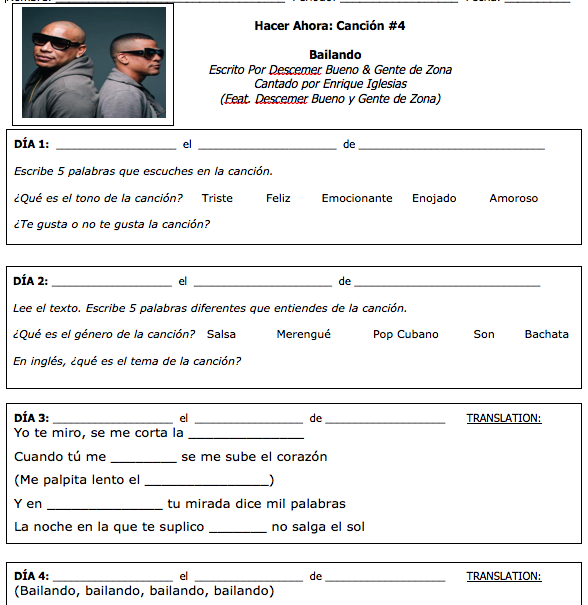
Song Warm-Up Procedure in the World Language Classroom

As mentioned before, song warm-ups bring incredible life to my classroom. In the first five minutes of class, students are energized and re-set to a full immersion classroom experience. 

The song warm-up procedure is simple, but knowing the pattern of each song's warm-up helps students to feel comfortable in the activity and keeps the warm-up relatively simple.


Each day, students begin by writing out the date in the target language. 

Day 1

In day one, students begin by listening to the song in its entirety. This gives students a day to analyze the words of the song to see which words they recognize.


Escribe 5 palabras que escuchas en la canción. 

Write five words that you hear in the song. 

Then students are asked to analyze the tone of the music of the song. 

¿Qué es el tono de la canción? Triste? Feliz? Emocionante? Enojado? Amoroso? 

What is the tone of the song? Sad? Happy? Exciting? Angry, Loving?

Finally for Day 1, students are asked to analyze their opinion of the song. 
        
¿Te gusta o no te gusta la canción?

Do you like the song or do you dislike the song?

Day 2

In day two, students again listen to the song in its entirety, but this time they read the lyrics of the song (Day 3 - 7) and chose five different words that they understand from the song. This gives students another day to analyze written text of the song to see which words they recognize. 


Lee el texto. Escribe 5 palabras diferentes que entiendes de la canción. 

Read the text. Write five words different words that you hear in the song. 

Then students are asked to analyze the tone of the music of the song. 

¿Qué es el género de la canción? Salsa? Merengué? Pop Cubano? Son? Bachata?

What is the genre of the song? Salsa? Merengue? Cuban pop? Son? Bachata?

Finally for Day 2, students are asked to analyze the theme of the song. Spanish 1 completes this task in English.
         
En inglés, ¿qué es el tema de la canción?

In English, what is the theme of the song?

Day 3 through 7


In day three through seven, students again are listening to the song, but this time they are completing a different style of warm-up activity. Students complete a CLOZE listening activity, in which the teacher plays the section of the song for students for the appropriate day, and students fill in the blank spaces with the appropriate word from the song. 


After they have completed the CLOZE activity and listened to the excerpt twice, I usually give students one minute to translate the stanza themselves. In Spanish 1, students are asked to translate at least two words from each line of the text during this time. In Spanish 2, students are asked to translate as much of the stanza as possible, with the help of a dictionary. 

After the three minutes have passed, I ask students (in the target language) for the answers to the blank spaces, and then with student assistance, we translate the stanza together. 

Day 8

In day eight, students watch the music video and write three sentences in the target language that describe what they see in the video.

Day 9 culminates the song warm-up procedure with a CLOZE activity exam that includes student's ability to analyze the song. 


If you would like to download a free song warm-up sheet and accompanying exam, please go to the following link:


Please let me know if you have any questions, and enjoy the light and life this procedure brings to your classroom!